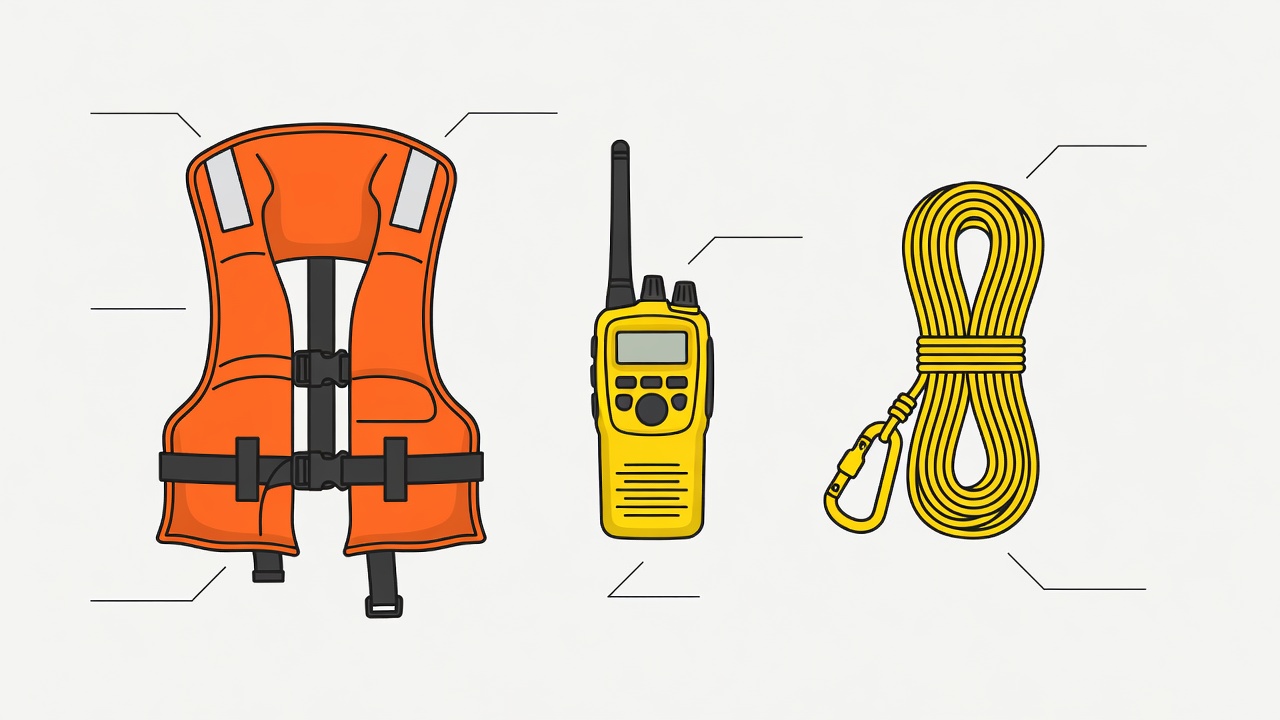
Begin with the boat, waters and crew
Requirements vary with flag, jurisdiction, vessel type, operating area and use. Establish the applicable rules before relying on any general list. A short sheltered trip may still involve cold water, a difficult recovery or a crew member with limited mobility. Distance alone does not describe the risk.
Use the inventory to connect equipment with a task: staying afloat, raising an alert, locating a person, recovering them, controlling fire or managing flooding. Identify who can do each task if the skipper is unavailable. Where your assessment exposes a training gap, adding hardware is not an adequate substitute.
The Maritime and Coastguard Agency, the US Coast Guard and local maritime authorities publish guidance within their respective responsibilities. The Royal Yachting Association and the RNLI also provide recreational safety information. Check current advice appropriate to your waters rather than combining unrelated lists into an assumed legal standard.
Fit personal equipment to the wearer
A lifejacket must suit the person, clothing and intended activity. Check the manufacturer’s size and weight guidance, adjustment procedure and any restrictions. Fit the supplied crotch straps as instructed. An oversized or poorly adjusted jacket may not perform as intended, even when its buoyancy rating sounds reassuring.
Inflatable and inherently buoyant designs have different advantages and maintenance needs. An inflatable jacket depends on its cylinder, firing mechanism, bladder and correct assembly. Automatic activation arrangements vary. A jacket for a child or a person with particular needs requires careful individual selection; do not assume an adult design scaled down will be appropriate.
ISO 12402 is a family of personal flotation device standards. The relevant marking can help identify performance and intended use, but it is not a complete suitability assessment. Check any harness and tether arrangement separately, including compatibility, attachment points and the risk of becoming trapped or dragged.
Keep the means of alerting available
A fixed VHF installation can provide useful coverage, but depends on its antenna, connections and power. A waterproof handheld may offer a separate option with more limited range. Learn the radio’s controls and obtain the operator qualifications and station licensing required where you operate.
For DSC equipment, correct configuration matters. Confirm the Maritime Mobile Service Identity and the source of position data using the manufacturer’s testing procedure; never transmit a false distress alert for practice. A mobile phone can be useful, but coverage, battery life and water exposure make it unsuitable as the only plan in many areas.
An EPIRB or personal locator beacon uses a different alerting system from a marine radio. Check registration, battery dates and the precise operating instructions for the device. Cospas-Sarsat supports satellite distress alerting, but carrying a beacon does not guarantee immediate rescue or remove the need for other appropriate equipment.
Think beyond spotting a person
A person-overboard plan needs a way to maintain contact, return safely and bring the person aboard. A recovery aid that cannot be rigged by the remaining crew is an incomplete solution. Consider the boat’s freeboard, access points and the difficulty of helping an exhausted or unconscious person.
Practise equipment handling in controlled conditions with suitable supervision. Do not put someone in the water simply to test an improvised plan. Locate throwing aids, recovery lines and lights so that they can be deployed promptly without fouling other gear.
Make emergency storage unambiguous
| Equipment group | Access question | Storage consideration |
|---|---|---|
| Personal flotation | Can every wearer identify and fit theirs? | Dry, ventilated and protected as instructed |
| Fire equipment | Can it be reached without approaching the likely fire? | Correct brackets and unobstructed access |
| Distress equipment | Can another crew member find and operate it? | Clearly labelled, restrained and within service dates |
| Flooding response | Are pumps and relevant shut-offs accessible? | No cargo over valves, strainers or handles |
First-aid supplies should suit the people aboard and the likely delay before professional help. Keep a usable inventory and replace expired or damaged contents. Fire extinguishers, fire blankets, liferafts and distress signals require selection and storage appropriate to the vessel; this guide does not prescribe a universal set.
Turn inspection into a repeatable routine
Follow each manufacturer’s inspection and service schedule. Record dates, model details, battery or cylinder specifications and the location of manuals. Some checks belong with the owner; others require an authorised service facility. Do not substitute an informal visual inspection for a required professional service.
Before departure, brief the crew on lifejackets, communications, emergency exits, relevant shut-offs and recovery equipment. Ask another person to locate key items without prompting. If the exercise reveals confusion, change the arrangement while still alongside. Readiness is demonstrated by a usable routine, not by the length of an inventory.